Lets begin with the Lumiere Brothers. In 1985, Auguste and Louis Lumiere invented the cinematographe. The cinematographe was an invention that combined a camera, with a printer and a projector.

Image source link.
If you click on the image above, you can see what the standard cinematographe looked like.
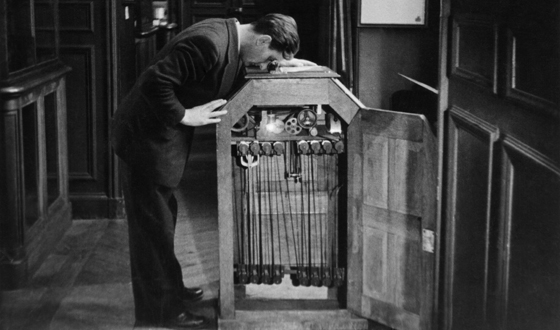
A man named Thomas Edison invented an incredible device named a Kinetoscope. The Kinetoscope allowed motion picture to be viewed. Thomas also invented the Kinetograph, which was used for capturing motion picture.

Image source link.
If you click on the image above, you can see what the kinetoscope looked like and how it was used.
Another early film editing pioneer was David Llewelyn Wark "D. W." Griffith.
D.W. Griffith used close-ups, camera movements and lighting. He did this to emphasise the action in the film.
The clip below is from D.W. Griffiths movie, Birth of a Nation.
The clip demonstrates early use of providing information, as seen at 1 minute and 28 seconds into the video.
It also demonstrates different sized shots and framing throughout.
As seen at 6 minutes and 45 seconds, a fade in is used. This is one of the very early uses of the fade effect.
D.W. Griffith also pioneered the use of invisible editing, this is where cuts between shots match the action in the film correctly.
This editing style is used commonly in cinema today as it allows shots to appear quickly.
The short clip below is a perfect example of an invisible edit.
I will now look into the Soviet Russian pioneer Sergei Eisenstein.
Image source link.

Sergei came up with five types of montage.
These are metric, rhythmic, tonal, over-tonal and intellectual.
Metric montage is when shots are cut at equal lengths without considering what is on the screen.
Rhythmic montage is when shots are cut together based on timings and also considering what is on the screen.
Tonal montage is when shots are cut together for their emotional content, such as a person starting to cry and then moving closer to their face, with an invisible cut for example.
When all three of the above are used, this is called an over tonal montage.
Intellectual montage is when shots are put together to give a metaphorical meaning, this is called an intellectual montage.
I will now look into Russian filmmaker Lev Kuleshov.
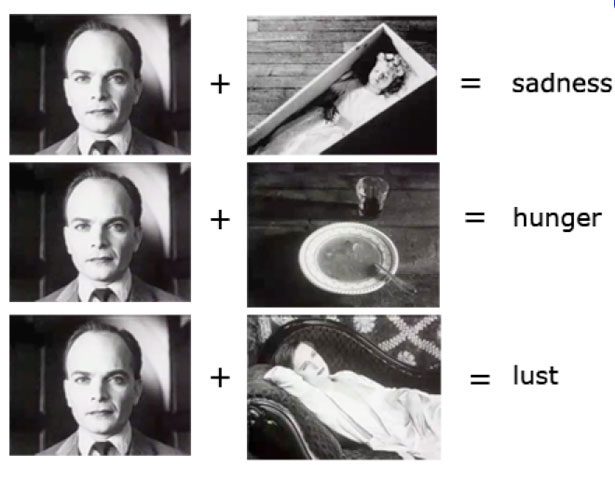
Kuleshov used an editing technique, famously known as the 'Kuleshov effect.'

Image source link.
The image above is taken from the original Kuleshov's experiment.
By projecting a persons face, followed by an image, it paints a picture to the viewer what they feel.
For example, when an image of soup is shown after a person, the person must be hungry and wants the soup that is shown.
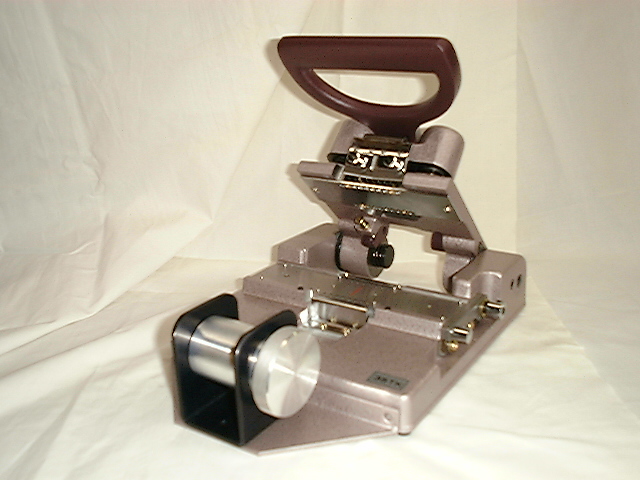
Editing used to be done manually by physically cutting and pasting a film together using a tool called a splicer.

The image above is of an early splicer. Once the film was finished being cut, the film would then be threaded onto a machine with a viewer.
Nearly all films now are done digitally, a lot using a program named Final Cut Pro.


Left image source link.
Right image source link.
There are three types of editing.
These are:
- Film Editing - As mentioned previously, this is the physical cutting of film and piecing it together with a splicer.
- Linear editing - This is where the film has to be assembled in order.
- Non-Linear editing - This is what is used in Final Cut Pro. It is where any film can be accessed regardless of where in the sequence it is.




No comments:
Post a Comment